Your vendors are not going to read a twelve-page planning document on wedding day. They will read one page: the run of show. Get that page right and the day runs itself. Get it wrong and you spend the reception on the phone.
This is the process professional planners use to build a wedding day timeline that holds up in real life — plus a full example run of show for a 4:00 PM ceremony you can adapt to your next wedding.
Run of show vs. the couple's timeline
These are two different documents, and mixing them is the most common mistake we see.
- The run of show is internal. It includes vendor load-in, room flips, who is responsible for each moment, and the notes you would never send to a couple.
- The couple's timeline is the simplified version: when to be ready, when the ceremony starts, when dinner is served. No logistics noise.
Build one master schedule, then decide which moments each audience sees. Maintaining two separate files by hand is how versions drift apart.
The six columns every run of show needs
| Column | Why it matters |
|---|---|
| Start time | The single reference everyone works from. |
| Duration | Lets you see instantly what a 15-minute delay pushes into the next block. |
| Moment | Named the way vendors talk: first look, room flip, golden hour, send-off. |
| Location | Critical the moment the day uses more than one space. |
| Responsible | A vendor or team member on every line. No line without an owner. |
| Notes | Cues, songs, rain-plan triggers, and anything you would otherwise repeat ten times. |
Build the timeline backwards, not forwards
Starting at “hair and makeup at 9:00 AM” is how timelines drift. Start from the fixed points instead.
1. Lock your three anchors
Ceremony start time, sunset, and the venue's hard end time. Everything else moves around those. Sunset matters more than planners expect: it decides when golden hour photos happen, and it moves by more than an hour across a Florida season.
2. Work backwards to getting ready
From the ceremony, subtract guest arrival, travel, dressing, first look, and beauty services. If the math ends before your beauty team can realistically start, the problem is the ceremony time or the number of services — not their speed.
3. Work forwards into the reception
Cocktail hour, entrance, dinner service, toasts, dances, cake, open dancing, send-off. Confirm dinner blocks with the catering captain, not with a template — service style changes the numbers.
4. Put a name on every line
If a moment has no responsible vendor, it will happen late. Assign the photographer, caterer, DJ, or assistant to each block, with contact details on the document itself.
5. Add buffers where days actually slip
- 10 to 15 minutes after hair and makeup.
- 3 to 4 minutes per family photo grouping — count the groupings, not the block.
- Travel time plus 50% in Miami, Orlando, or any resort corridor at peak hour.
- 20 to 30 minutes before sunset for couple portraits.
- 10 minutes between toasts and first dance so the floor can clear.
Example run of show: 4:00 PM ceremony, 120 guests
A single-venue resort wedding with a room flip between ceremony and reception. Use it as a skeleton and adjust to your venue, service style, and sunset.
| Time | Duration | Moment | Responsible |
|---|---|---|---|
| 8:00 AM | 30 min | Planner arrives, venue walkthrough | Lead planner |
| 9:00 AM | 3 h | Hair and makeup begins (bridal suite) | Beauty team |
| 10:00 AM | 2 h | Vendor load-in: florals, rentals, AV | Florist, rentals, DJ |
| 12:00 PM | 45 min | Lunch for couple and party | Assistant planner |
| 1:00 PM | 1 h | Detail and getting-ready photos | Photographer |
| 2:00 PM | 30 min | Getting into the dress and suit | Beauty team, photo |
| 2:30 PM | 30 min | First look | Photographer, video |
| 3:00 PM | 30 min | Wedding party photos | Photographer |
| 3:30 PM | 20 min | Guest arrival, welcome drinks | Catering, ushers |
| 4:00 PM | 30 min | Ceremony | Officiant, planner, DJ |
| 4:30 PM | 90 min | Cocktail hour | Catering, DJ |
| 4:45 PM | 45 min | Family and couple portraits | Photographer |
| 5:45 PM | 15 min | Room flip check and final seating sweep | Planner, catering |
| 6:00 PM | 15 min | Guests seated, grand entrance | DJ, planner |
| 6:15 PM | 15 min | Welcome toast and blessing | Host, DJ |
| 6:30 PM | 75 min | Dinner service (3 courses) | Catering captain |
| 7:15 PM | 25 min | Golden hour couple photos | Photographer |
| 7:45 PM | 20 min | Toasts | DJ, catering |
| 8:05 PM | 15 min | First dance and parent dances | DJ, photo, video |
| 8:20 PM | 10 min | Cake cutting | Catering, photo |
| 8:30 PM | 2 h 15 min | Open dancing | DJ |
| 10:15 PM | 15 min | Late-night bites, sparkler send-off setup | Catering, planner |
| 10:45 PM | 15 min | Send-off | Planner, photo |
| 11:00 PM | 1 h | Vendor breakdown, personal items to suite | All vendors, planner |
Note the two overlaps: family portraits run inside cocktail hour, and golden hour photos sit inside dinner service. Those overlaps are intentional, and they are exactly the lines your photographer and catering captain need to see before the day.
Florida and destination weddings: what changes
- Heat and rain windows. Outdoor blocks between noon and 4:00 PM need shade, water, and a rain-plan trigger time written into the document, not decided in the moment.
- Guest transport. Shuttles from hotels turn a 15-minute drive into a 40-minute operation. Give it its own line with a responsible person.
- Two languages. If part of the family and some vendors work in Spanish, they need the schedule in Spanish. A bilingual timeline prevents the “nobody told me” conversation during cocktail hour.
- Sunset math. A 7:30 PM sunset in June and a 5:40 PM sunset in December produce two completely different reception timelines for the same venue.
Five mistakes that break a wedding day timeline
- Times without durations. A list of times hides the knock-on effect of every delay.
- Moments with no owner. Anything “everyone” is doing gets done late.
- Family photo lists estimated as one block. Count groupings and multiply.
- Emailing a PDF three weeks out and never updating it. Vendors will work from that file, not from your latest change.
- Sending the internal version to the couple. Load-in times and vendor notes create questions you do not need to answer.
Build it once, share it with everyone
Spreadsheets work until the third change. After that, the version your photographer has and the version in your inbox are different documents — and nobody knows which one is real.
In The Bridal Link you build the run of show inside the wedding itself: each moment with its time, duration, location, and the vendor responsible, pulled from that client's vendor list. You export the wedding-day PDF for your team and choose which moments the couple sees in their portal, in English or Spanish.
Build your next run of show in minutes
Create the timeline for an upcoming wedding, assign vendors to each moment, and export the PDF your team can follow. Free trial, no credit card required.
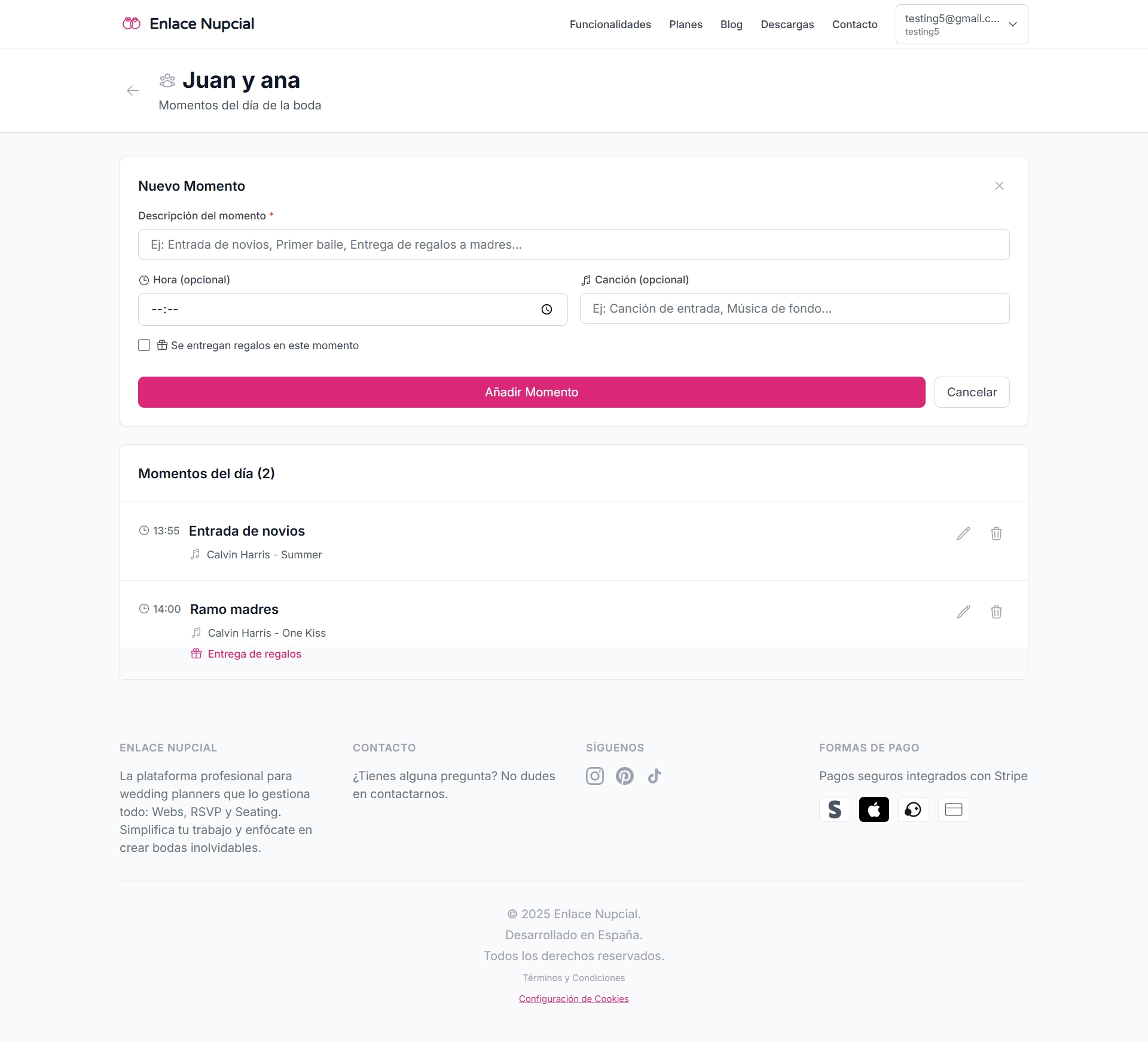
Wedding day moments with times, durations and the vendor responsible for each block
Frequently asked questions
What is the difference between a wedding timeline and a run of show?
A wedding timeline is usually the simplified schedule the couple and guests see. A run of show is the internal document your vendors and team work from: every moment with its start time, duration, location, and the person or vendor responsible, including load-in and breakdown.
When should I send the run of show to vendors?
Share a draft two to three weeks before the wedding so photographers, caterers, and the DJ can flag conflicts, then send the final version in the last week. If your timeline lives in a shared tool, vendors always open the current version instead of an outdated PDF.
How much buffer should a wedding day timeline have?
As a rule of thumb, add 10 to 15 minutes of buffer after getting ready, family photos, and any transport between locations. Those three moments are where most wedding days lose time.
Do I need a separate timeline for each partner?
Usually yes. Getting-ready schedules rarely match, so most planners run parallel tracks — one per partner plus a general timeline for the event — and merge them from the ceremony onwards.